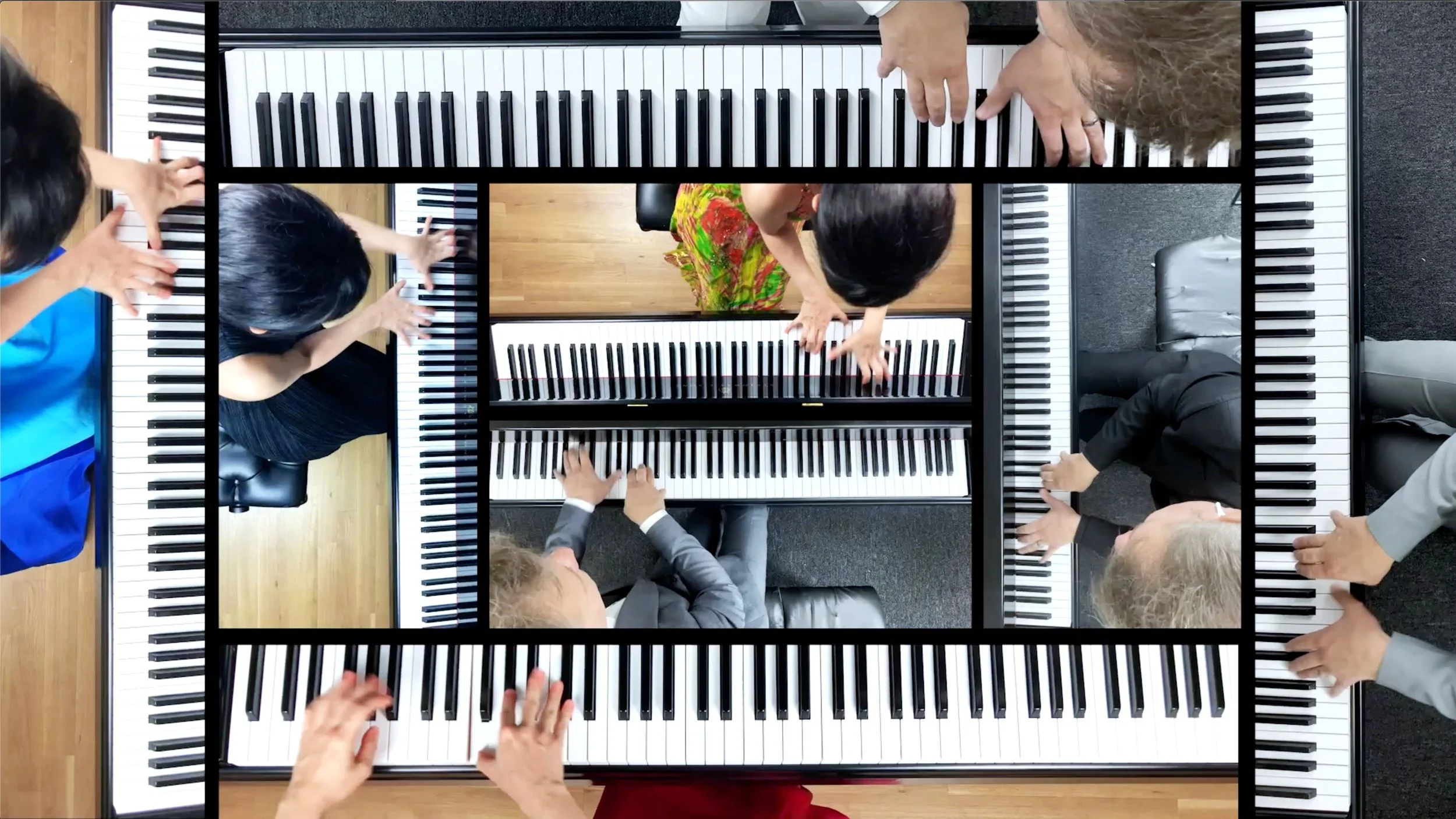
Islamey: Kaleidoscopic Fantasy for Two Pianos
Balakirev’s Islamey is notorious for being one of the most difficult pieces in the entire solo piano repertoire. Mily Balakirev (1837-1910), himself a virtuoso pianist, deemed his own composition “unplayable” and that he “couldn’t manage” various passages in the piece. The great pianist Anton Rubinstein, who premiered the piece in 1869, proclaimed that “few would be able to master it.” Even Maurice Ravel challenged himself to create a work “more difficult than Balakirev’s Islamey.” (The result? Gaspard de la nuit.) However, Balakirev was not merely interested in creating a pianistic Everest; he was primarily inspired by his ethnomusicological discoveries in the Caucausus region, located at the border between Europe and Asia and between the Black and Caspian Seas, in the 1860s. This region is known for its astonishing linguistic and cultural diversity. It was here that Balakirev came upon a melody that would eventually make its way into his “Oriental Fantasy.” As he wrote to his friend Eduard Reiss:
“…the grandiose beauty of the luxuriant natural surroundings in that region and the commensurate beauty of its inhabitants, all of this taken together left a deep impression on me. As I was interested in the local folk music, I sought out the acquaintance of a Circassian prince, who frequently came to see me and played folk melodies on his instrument, which bore some resemblance to a violin. I took a special liking to one of those melodies, a dance tune called ‘Islamey,’ and with a view to the work I had in mind on [the symphonic poem] Tamara, I began to arrange it for the piano. The second theme was communicated to me in Moscow by an Armenian actor [K. N. de Lazari, a member of the Bolshoi Theatre] …and is, as he assured me, well known among the Crimean Tatars.”
In a flurry of inspiration (and contrary to his usual years-long compositional process), Balakirev wrote the work over the span of a single month in 1869. In 1902, he revised the work with several ossia passages.
Fast forward to 2020: we decided to tackle the challenge and honor Islamey’s ambitious pianism by taking on several piano parts each, over a dozen altogether! Rather than split the original into several easier piano parts, we added plenty of extra material in true Anderson & Roe style. (Seriously, each of these piano parts is a colossal challenge!)
At the crux of our over-the-top adaptation is the spirit of a piano battle: the composition (and accompanying music video) revolves around the competition between two teams, in this case Team Liz and Team Greg. Throughout, there are friendly and rollicking hootenannies with each of us jumping into the middle to show off our pianistic chops. The individual piano parts in combination are reminiscent of a kaleidoscope, with the original material being reflected and refracted upon itself by the multitude of pianists. The first third of the work is performed slower than the solo version to bring out the dance-like lilt and highly complex rhythms. The middle section is an embellished, grandiose version of the original, ending with some killer scales. Finally, the last third proceeds at a demonic pace, performed faster than the original version could ever be played; it gains such momentum that the perceived pulse becomes more expansive and the music essentially become airborne, soaring to a bravura and triumphant conclusion.